Species-appropriate pruning, deadwood removal, crown cleaning, and clearance work for residential and commercial trees across Phoenix, AZ and Maricopa County.
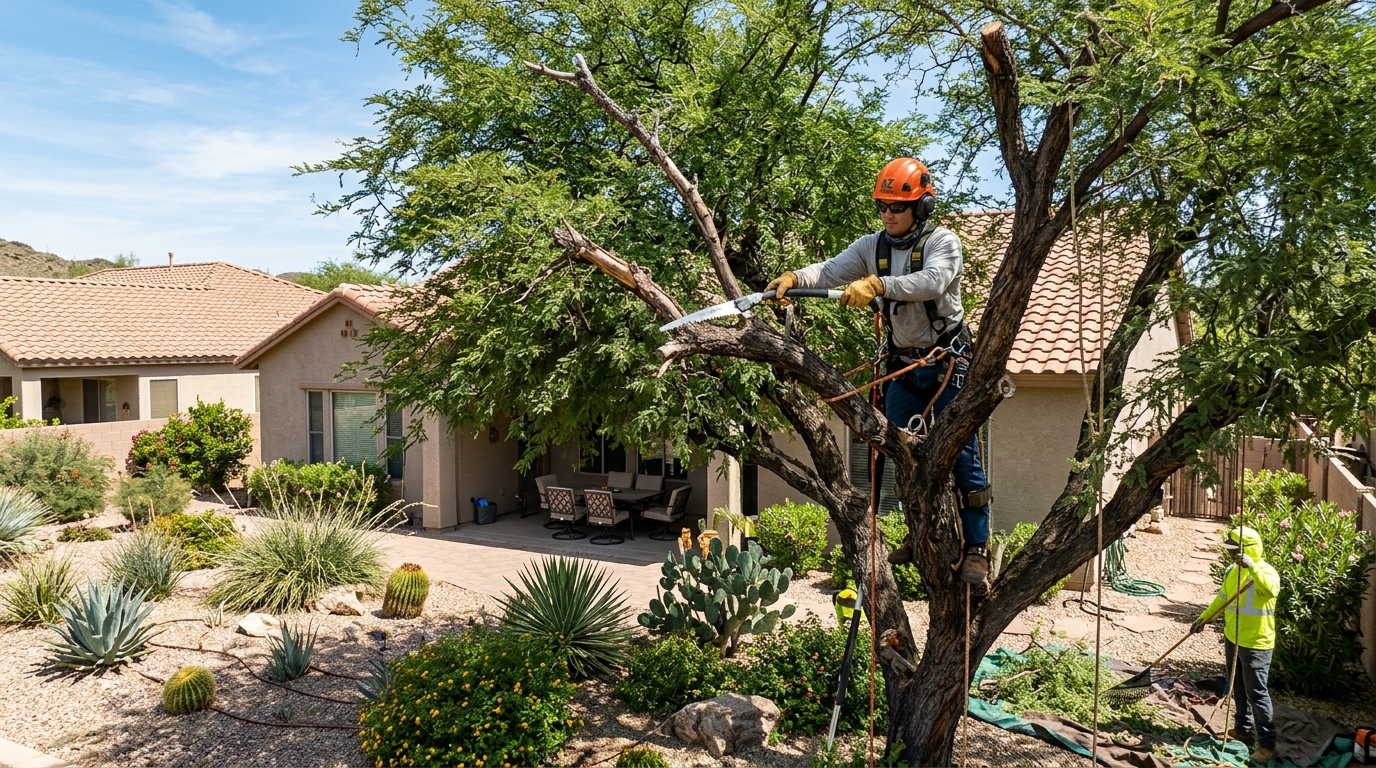
Tree trimming in the Phoenix, Arizona area serves multiple objectives: removing dead and dying branches, reducing wind resistance before monsoon season, maintaining safe clearance from structures and walkways, and improving the overall structural integrity of the tree. The right pruning approach depends on the species, age, current condition, and the specific goals of the property owner.
Our crew uses species-appropriate pruning techniques — targeting specific branches based on their condition and position rather than indiscriminately cutting for shape. We remove deadwood, thin overcrowded canopies where appropriate, reduce weight on overextended limbs, and create clearance from roofs, walls, walkways, and other structures.
Topping — the harmful practice of cutting main branches to stubs — is not a service we offer. It triggers rapid, weakly attached regrowth, increases vulnerability to pests and decay, and creates more hazardous conditions than the tree presented before the cuts.
Each trimming project starts with an assessment of what the tree needs. The following pruning objectives are commonly addressed during our service visits.
Selective removal of dead, dying, diseased, and broken branches throughout the canopy. Crown cleaning reduces falling-debris hazards and improves the tree's overall appearance without altering its natural form.
Targeted cuts to improve branch architecture, reduce co-dominant stems, and address weak attachment points. Structural pruning is most effective on younger trees but can also benefit mature trees when performed carefully.
Shortening overextended branches to reduce the leverage load on attachment points. This is particularly important for Phoenix, AZ trees before monsoon season, when heavy winds stress long, heavily loaded limbs.
Raising the canopy or directing growth away from rooflines, block walls, walkways, driveways, and structures. Clearance work maintains safe distances and prevents physical contact that can damage both the tree and the structure.
Selective thinning or windowing within the canopy to restore sight lines, improve light penetration, or open views while retaining the tree's overall form and shade coverage.
Focused removal of dead branches throughout the canopy. Deadwood is a falling hazard in any wind event and is the single most impactful pruning task for reducing risk on mature trees.
Different tree species respond to pruning differently. What works well for a mesquite may not be appropriate for a palo verde, an ash, or a citrus tree. Our approach accounts for these differences.
Most landscape trees benefit from inspection and maintenance every one to three years, depending on species, growth rate, and proximity to structures. Fast-growing species like mesquite may need more frequent attention, while slow-growing native trees may need less. An on-site evaluation helps determine the appropriate schedule for your specific trees.
Deadwood removal and light clearance pruning can generally be done year-round. However, heavy structural pruning during the hottest months can expose bark to sunscald and increase stress on the tree. We advise on timing based on species and the scope of work planned. Pre-monsoon trimming — typically late spring — is often ideal for wind-resistance preparation.
Trimming involves selective removal of specific branches based on their condition, position, and contribution to the tree's structure. Topping is the indiscriminate cutting of main branches to stubs, which causes rapid, weakly attached regrowth, decay at cut sites, and increased long-term hazard. We do not practice or recommend topping.
In some cases, removing deadwood and improving air circulation through the canopy can benefit a stressed tree. However, trimming alone does not address root-zone problems, irrigation issues, or advanced disease. For trees showing signs of decline, we recommend a tree health care evaluation to identify the underlying causes before determining whether pruning, other interventions, or removal is most appropriate.
Yes. We provide dedicated palm tree trimming services for Mexican fan palms, California fan palms, date palms, and other species common in Phoenix, AZ landscapes. Palm trimming involves safe removal of dead and dying fronds, seed stalks, and loose debris.
Contact us to schedule an on-site evaluation. We assess each tree individually and provide clear recommendations on what pruning work would be beneficial.